Much of my favorite literature (like George Perec, and more recently Eunoia by Christian Bök) is written within rigid limits. I was thinking about this when I was reflecting on the text messages my friend and I used to send to each others’ Seiko Messagewatches. The Messagewatch was a pager in the size and shape of a watch that enjoyed a little boom in popularity in the nineties. Here’s a picture:
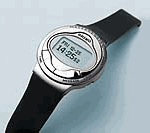
Seiko saw where things were going with mobile phones and, sadly, decided not to fix a number of Y2K bugs in the Messagewatch system. The service was discontinued on December 31, 1999.
Messagewatches could receive messages — very simple and very short ones. The pagers had simple watch displays so they could only show messages if they would fit and used characters that could be displayed on screen. I remember how difficult it was trying to think of phrasings that could get a given point across while still fitting within the Messagewatch’s limitations.
Because the watch had a two-line display, words would be split automatically as they are in this following example which gives you an idea for the medium messagers were working in:

I remember receiving the message "hey there ace" on multiple occasions. It’s a less than completely ideal phrase because its impossible to display with splitting "there." Ideally, messages would also be structured with spaces in such a way that words would not be split between the lines.
Feeling nostalgic, I thought a good way to honor the memory of the Messagewatch would be with a poem about it. That said, I thought I could both play to my own artistic sensibilities (the "writing within rigid limits shtick") while appropriately memorializing the watch by writing poetry that could be displayed, without words broken between lines, on the display of a Seiko Messagewatch.
That said, there are pretty serious restrictions working in the "Seiko Messagewatch poetry" genre. The executive summary is that:
- No words can contain letters that cannot be drawn unambiguously in upper or lower case without diagonals (i.e., no M, W, X, Z, V, or K);
- No stanza can be longer than 16 characters long (including spaces);
- No single word can be over 8 characters long;
- No series of words can be such that they need to split a word over the line-gap between the 8-9th and characters;
The poem I have created tries to capture my feelings about the Seiko Messagewatch, a technology that was not without warts and limitations but that taken from us all early: the only real Y2K tragedy loss I experienced personally.
Without further ado, my Tribute to the Seiko Message Watch:








I’m a Perec fan too!
I just aquired 2 Seiko messagewatches.
I am interested in finding out what they are worth.
And if someone may be interested in them.
They are new in the box, models SGP 603 and SGP 702.
Any info would be great.
Thanks
Scott
I worked for Seiko right up till we shut the doors. The reason Seiko closed its doors was due to lack of sales in the greater New York area.
It had NOTHING to do with Y2K!
I don’t remember You..what dept. did you work for?
I use to work at this company back in 93.I was the Data Entry Dept. ! 1 person.I gave away about 10 watches tfriends to get service from them, then the company got in trouble with customers taking FREE watches MA50’s back to freddie’s(FRED MEYERS) and getting money for them.I mention to Mike Park the CEO that this might happen…No wonder the Company Failed. I got let go after 11 months!
The Message Watch originally was the brainchild of a small group of engineers in San Francisco whose company for funding the project was called ATI.
Seiko Communications of America Inc was formed after Seiko moved in from miniturinzing the electronics to taking over nearly every aspect of the project. It’s headquarters were in Beaverton, Oregon and one of its principals was a member of the family who owns the watch maker. At one time Seiko was one of the largest family owned firms in terms of net worth, some $70B in the 1980s.
ATI/SCOA held several unique patents, including the HSDS protocol and the utilization of FM broadcast radio station subcarriers to deliver one-way data streams. The message watch was in effect a tiny FM receiver with filters selecting only the subcarrier with the 19.2kbps data stream.
After San Francisco, the message watch had markets in Los Angeles, NYC, Oregon, Washington, and Holland (in assoctiation with state-run Nozema) and briefly in China.
I was FM Network Engineer and traveled extensively to every market except China. Some of my tasks were FM transmitter tuning, mapping propagation, and a joy for me was visiting all the top-station transmitter hilltops coast to coast. For a time we had a unit on WYNY at WTC. I left the firm in 1994 after rumours told the family were to pull funding (WYNY monthly rental was alleged to be $10,000 per month!). There were patent battles with Swatch and cell phone data quickly replaced the one-way data path. Sales were sluggish due to poor consumer reaction to wearing what some called a “hockey puck,” but in the end it was seen that even good sales could not outpace the millions spent just installing and maintaining the network to compete with cheap pagers and the coming threat of cell phone data eclipsing the 19.2k data limit on FM subcarriers.
I find it curious there is no mention of the Message Watch on wikipedia and even the patents are obscured today.
I still have an old Message Watch and always wondered ik I could send a message to it, using a small FM-transmitter. Do you have any idea if and how it can be done?
I would like to know the frequency
what frequency did these watches operate on genesisproject2006@yahoo.com
I made the product demo in 1997 for the MessageWatch. Running time was about 4 min. It was a cool watch, but I saw the problem with costs for other cities to install, rental, etc. on the FM stations.
Today would have been cheaper. Would be using 3-4g Wifi,etc. Of course, I just saw the new Apple Watch, and it is amazing.
I loved my Seiko “Receptor” watch back in the 90′. Same watch as the Messagewatch?
I am a Seiko fan boy to this day. Automatic watches catch my eye more and more. My Samsung Gear Fit goes on my right wrist to count steps, etc. My “real” watch goes on the left. I can rock a Japanese Domestic Market (JDM) Seiko SARB 065 Cocktail Time and Gear Fit at the same time. And 9 times, or more, out of 10 I’ll get questions about the Gear Fit.
Do you have the presentation for the Seiko Receptor/Smartwatch?
Philip
I still have my message watch, what do you do with it now / CAN IT BE ACTIVATED AGAIN. I WOULD LIKE TO GIVE IT TO MY GRANDSON. IN GRADE SCHOOL. THANKS ROSIE
The MessageWatch will never work again. It will probably still work as a watch though!
OH WELL , THE BOX WAS CUTE ! THREW IT! NEVER HEARD BACK ON THE JUDGMENT OF THE LAW SUIT EITHER!
I was on of the staff that were offered golden handcuffs to close the place down. What many did not know we had a 3rd generation watch which just hit the market. The display was a full dot matrix. Don’t remember the resolution but I did a image of the Coke and Pepsi logo’s for a demo we put
on at PIR. Portland International Raceway ( https://portlandraceway.com/ ).
We had a complete transmission systems in the back of a van, and were transmitting pretty much
real time racing info and once in a while advertisements to about 50 watches.
Sadly Seiko dragged their feet for so long, it was too late in the game, and I remembered being chastised for setting up the companies first website with a URL where you could enter a message via a browser. The suits&ties said the Internet was a waste of the only for “geeks”.
What else .. I was so depressed I missed the opportunity to take home that demo system, it did everything except customer accounting. I remember it having a nice 20 W FM transmitter. When
I did finally think about it, I found out that under the table it has be ‘sold’ with the scrap to a friend of the ‘family’.
There were two families, the Seiko’s and the P***s. The P***s were I think all brothers. Can’t say
anything, don’t want to get severed papers even after all these years.
Seiko would rotate their Japanese execs through us about 1 per year. One refused to leave his office except for going home and to lunch. All correspondence had to go first to his secretary be translated in to Japaneses, back to his secretary and then back to you. He had a private table at the restaurant with his private bottle of sake.
I still have a few of the 3rd generation watches. A feature never advertised is you could put them
in diagnostics mode and display pretty much a FM spectrum analyser.
With all that, they had some pretty impressive engineers getting all those features in such a small space back then was quite something.
Thanks for the memories
-pete
This is so wonderful. I had no idea about the third generation watch! Thank you so much for sharing!
Any idea if it’s possible to send a message using a small FM-Transmitter?
I still got that dot matrix MessageWatch somewhere. It was sold in The Netherlands and worked well after Y2K up until 2002. No Y2K problems here :-)
Worked for Motorola (Director of Industrial Design) in the 70’s, Motorola combined there efforts with Seiko, built a “Pager Watch”.
Never made it to the market (cost was the factor). Have one of the few, “Pager Watches”. (Had a battery built into the band).
Remember getting off a plane and my wife paging me on my “Pager Watch”!
Message would marque across the face. Passer by almost flipped, seeing it in action!
Wonder if it’s worth anything today as a collector’s piece?